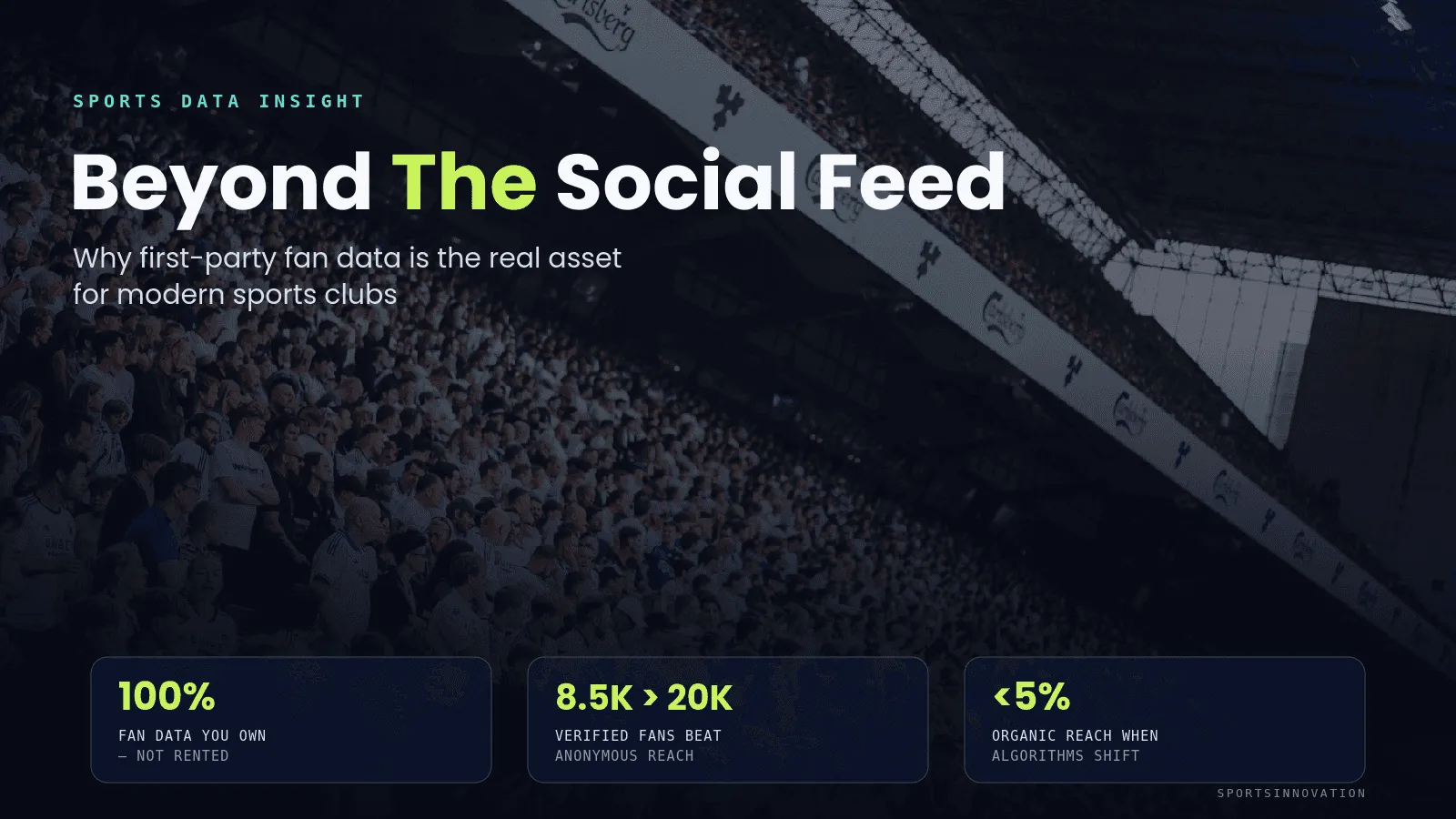
Beyond The Social Feed
By Martin Svensson · 25. June 2026
For years, professional sports clubs measured digital success in followers. Millions of likes, views, and shares across Meta, TikTok, and X were worn as badges of honor. But in 2026, the landscape has shifted. Clubs that rely solely on social platforms are running into a hard truth: you don’t own your audience — and that comes with real limitations. Third-party cookies are gone, algorithms keep moving the goalposts, and organic reach keeps shrinking. Clubs can no longer afford to rent access to their own fans. To build a sustainable, future-proof commercial model, sports organizations need to pivot to a first-party fan data strategy — and a dedicated club app is one of the most effective ways to get there.
What Exactly Is First-Party Fan Data?
In a sports context, first-party data is information your club collects directly from fans, with their explicit consent. It belongs to you — 100%, independent of any third-party platform. And once you own it, you can put it to work.
Demographic Data:
Verified email, date of birth, location, family status
Transactional Data:
Season tickets, single matchday tickets, merchandise orders, food & beverage spend
Behavioral Data:
App opens, articles read, videos watched, push-notification click-through rate
Engagement Data:
“Man of the Match” votes, quiz completions, score predictions, survey responses
The Risk of “Rented” Audiences
When a club boasts 500,000 Instagram followers, it feels like a major commercial asset. But if the platform changes its algorithm tomorrow, organic reach can drop below 5%. And social networks won’t hand over the granular data — who clicked your link, what merchandise they prefer, or whether they already hold a season ticket. In practice, you’re paying to reach your own fans through ads on someone else’s platform. Shifting the focus to first-party data — captured through a dedicated, white-label club app and an integrated fan ecosystem — lets you bypass the middleman and build a direct line to your fans.
3 Reasons First-Party Data Drives Commercial Growth
1. Unlocking Hyper-Personalization
Not all fans are the same. A 19-year-old ultra in the hardcore section has nothing in common, buying-wise, with a 45-year-old parent sitting in the family stand with two kids. Feed first-party data into a Sports CDP (Customer Data Platform) — such as the one built into the Sportsinnovation white-label app — and you can segment your audience by real behavior, not guesswork:
– The Family Segment: automatically trigger in-app or email offers on children’s merchandise and family meal deals at the stadium.
– The Away-Fan Segment: identify fans who consistently travel to away games and feed them targeted travel logistics, away-kit offers, and exclusive behind-the-scenes content.
– The VIP/B2B Segment: separate corporate ticket holders from general fans to deliver tailored networking invitations and high-end hospitality offers.
2. Eliminating the “No-Show” Cost
One of the biggest financial leaks for modern clubs is the empty season-ticket seat. When a fan stays home, the club loses secondary revenue on food, drinks, and merchandise — not to mention atmosphere. With first-party behavioral data, your platform can flag a season-ticket holder who hasn’t opened the app or scanned a ticket in two consecutive games, and send a friendly, automated nudge toward the app’s ticket-sharing or resale feature — freeing up the seat for a fan who’ll actually show up. FC Copenhagen and Brøndby IF already build on this principle with a points system: fans earn points for showing up, and if they fall short, renewing the season card the following year isn’t guaranteed.
3. Multiplying Sponsorship ROI
Traditional stadium sponsorship — LED boards, static signage — is notoriously hard to measure. Modern sponsors want data, attribution, and proof of return on investment. When you own your fan data, you can offer sponsors high-impact digital inventory backed by hard numbers. Instead of selling “visibility to a crowd of 20,000,” you can sell “direct digital engagement with 8,500 verified local car owners aged 25–50 who played the in-app Match Predictor.” That level of targeting commands premium pricing, because brands can track impressions, click-through rates, and real conversions — not just exposure.
The Path Forward: How to Capture Fan Data
Capturing valuable first-party data is a fair exchange: fans happily share their information and log in when the digital experience makes their match-day journey better. The clubs getting this right are building unified, mobile-first ecosystems — ticketing, loyalty, merchandise, and exclusive content such as live audio, voting, and gamification, all inside a single club app. Data collection happens naturally, at every touchpoint, without ever feeling like a transaction. The shift from vanity social metrics to owned first-party data is no longer a luxury reserved for elite clubs. It’s the foundational infrastructure every club needs to run a profitable, modern sports entertainment business.